Machua Appa
The Jungle BookMachua Appa is the head tracker of the Keddahs and one of the most respected figures in the elephant-catching camp. His authority rests on forty years of following elephants through the jungle, an experience that makes him both a practical judge of evidence and a ceremonial spokesman for the forest world. He first appears recognizing promise in Little Toomai, and he ultimately transforms the boy’s secret encounter with the elephants into an acknowledged initiation.
Identity and Standing
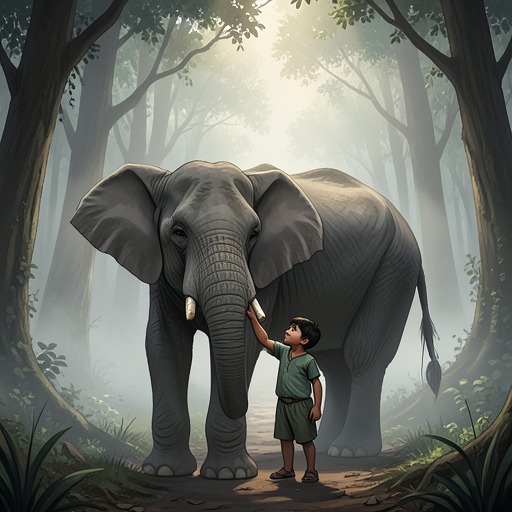
Machua Appa belongs to the permanent world of the Keddah: the catchers, hunters, beaters, drivers, and trackers who remain in the jungle year after year while other men return to the plains. When the season ends, he notices Little Toomai walking behind Big Toomai and remarks privately that the camp is sending away a valuable piece of elephant knowledge. His phrase identifies the boy as unusually suited to the jungle even before the larger company understands what he has done.
His standing is also measured by his relationship with Petersen Sahib. Machua Appa is described as Petersen Sahib’s other self, a partner whose knowledge complements the Sahib’s command. He has never seen a made road in forty years, a detail that places him firmly within the trackless forest rather than the settled world beyond it. His authority is therefore experiential: he reads the marks left by elephants, understands their movements, and speaks with the confidence of someone who has spent a lifetime attending to animals that remain mysterious to human observers.
Recognition of Little Toomai
Machua Appa helps expose the difference between ordinary skill and Little Toomai’s extraordinary experience. When Petersen Sahib asks what has been heard about the boy, Machua Appa explains that Little Toomai entered the Keddah during the last drive and threw a rope to Barmao while the men were trying to separate a young calf from its mother. The act establishes the child’s courage and practical ability, but Machua Appa’s later judgment shows that the boy has crossed beyond the ordinary work of a driver or catcher.
After Little Toomai returns from the hidden elephant dance, Machua Appa and Petersen Sahib follow the animals’ trail fifteen miles across the hills. Machua Appa needs only a brief inspection of the clearing to understand what happened. He sees the packed earth and counts seventy tracks crossing the river; he also identifies the mark where Pudmini’s leg-iron cut the bark of a tree, proving that Petersen Sahib’s elephant had been present. The physical traces confirm Little Toomai’s account and turn an apparently impossible story into verifiable knowledge.
The confirmation carries unusual weight because Machua Appa has followed elephants for forty years and has heard of only one other dance-place. He declares that the child speaks truth and admits that no child of man has ever been known to see what Little Toomai saw. His wonder is not naïve disbelief but professional astonishment: the oldest and most experienced tracker in the camp recognizes that the boy has witnessed a part of elephant life normally concealed from human beings.
Naming and Initiation
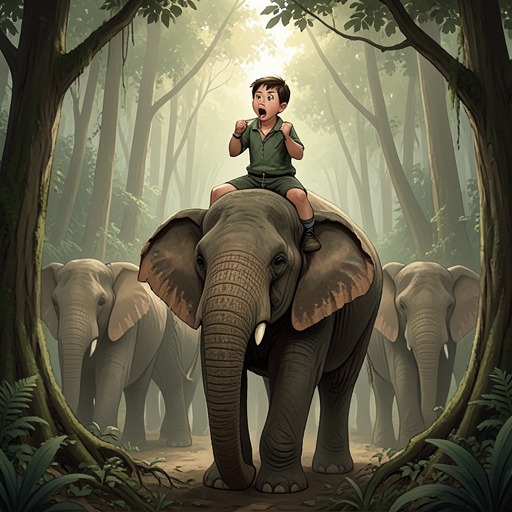
Machua Appa’s decisive action comes at the evening feast. After Little Toomai sleeps through the afternoon while the older men investigate his story, the camp celebrates the verified discovery. The boy is marked on the forehead with blood from a newly killed jungle-cock, a sign that he is a forester, initiated and free of the jungles. Machua Appa then rises and lifts him above his head before the gathered camp and the picketed elephants.
The naming speech changes Little Toomai’s public identity. Machua Appa announces that the boy shall no longer be called Little Toomai but Toomai of the Elephants, as his great-grandfather was called before him. He predicts that the child will become a great tracker, follow new, stale, and mixed trails with a clear eye, and survive the dangers of the Keddah. The speech does not merely reward an accomplished feat; it places Little Toomai within a hereditary and spiritual line of elephant knowledge.
Machua Appa also addresses the elephants as participants in the ceremony. He invokes Gunga Pershad, Hira Guj, Birchi Guj, Kuttar Guj, Pudmini, and Kala Nag, asking them to honor the boy who has seen their dances in hidden places. At his final command, the entire line raises its trunks in the Salaamut of the Keddah, a salute associated with the Viceroy of India. Under Machua Appa’s direction, the elephant camp itself becomes the witness that ratifies the new name.
Narrative Role and Significance
Machua Appa functions as the story’s most rigorous human validator of an event that lies beyond ordinary human understanding. Little Toomai’s account could have remained a child’s claim, but Machua Appa’s tracking converts it into evidence: footprints, packed earth, and the cut bark of a tree provide the material basis for belief. His expertise therefore bridges two forms of knowledge, human observation and the hidden social life of elephants.
His role also gives the ending its institutional force. Petersen Sahib can investigate and confirm the trail, but Machua Appa is the figure who interprets the discovery for the community and gives it a lasting name. The boy’s achievement becomes not a private adventure but an initiation witnessed by hunters, drivers, trackers, and elephants. Machua Appa’s authority turns a secret dance-place into a public inheritance and makes Little Toomai’s future legible: he is no longer merely a child accompanying his father, but Toomai of the Elephants, recognized by the people who know the jungle best.